Smarter trial design and enrollment with PRS
Enrich your clinical trial design with Polygenic Risk Score (PRS)-driven prognostic enrichment by targeting the patients most likely to experience your endpoint.
- Identify target populations prospectively using a proactive, data-driven process
- Higher event rates mean you reach the required number of events faster — shortening development cycles
- Pre-identify and pre-screen high-risk patients from a consented, recontactable multi-site network
- Validate your enrichment strategy against real-world clinico-genomic data before protocol lock
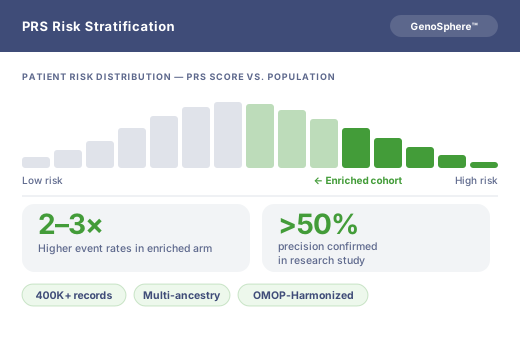
Driving trial efficiency through genetic precision
PRS-driven enrichment increases endpoint event rates, reduces sample size requirements, and improves probability of trial success — before you commit to a full-scale study.
Accelerated Timelines
Higher event rates mean you reach the required number of events faster — shortening development cycles and the path to regulatory submission.
Reduced Sample Size
Enrolling the highest-risk patients reduces the number of participants needed to achieve statistical significance, conserving R&D capital.
Increased Statistical Power
Genetic enrichment strengthens effect size and tightens confidence intervals — increasing probability of technical success and reducing risk of inconclusive results.
De-risk Before Launch
Validate your enrichment strategy against real-world clinico-genomic data before protocol lock — reducing the chance of a costly trial redesign.
How Prognostic Enrichment works
A streamlined process to build, validate, and deploy PRS-driven enrichment strategies using the Helix clinico-genomic platform.
Develop & Validate PRS
Validate existing or build new polygenic risk scores against 530K+ Exome+® sequencing records, validating performance across ancestries and linking scores to longitudinal clinical outcomes.
Design Enrichment Strategy
Model enrichment scenarios in real-world data to define genetic inclusion criteria and quantify expected gains in event rate, effect size, and sample size reduction.
Pre-screen & Recall Patients
Identify and pre-screen qualifying patients from our consented multi-site network. Engage participants through established recall workflows with high recontact rates.
Activate Partner Site Network
Deploy trials with our partner health systems, so patients participate without leaving their trusted care environment — to drive higher enrollment and retention.
Enroll & Analyze
Complete operational support for patient follow-up and analysis — reducing time to enrollment and delivering actionable results faster.
From genetic insight to enrolled patients
Helix brings every ingredient needed to run a PRS-enriched trial — validated scores, population-scale data, an activated site network, and clinical trial execution experience.
- 530K+ consented, sequenced Exome+® records with 13+ yr avg longitudinal EHR
- 15+ health system partners, majority activated for clinical trial research
- IRB-approved broad consent for life sciences recontact
- Analytical and operational support from design through enrollment and execution
Enhanced Lp(a) PRS for cross-ancestry enrichment
Helix can develop an enhanced PRS for Lp(a) that performs well across diverse ancestries — addressing the well-known failure of standard Lp(a) risk scores in multi-ethnic populations that lack KIV-2 data from Exome sequencing.
Pre-screening with the Helix PRS has the potential to significantly reduce screening failures and accelerate trial recruitment.
- >70%
- High-PRS patients confirmed with Lp(a) >120
- ~20%
- Without pre-screening have Lp(a) >120
- >10%
- Successful recontact rates
Ready to accelerate your research?
Connect with our team to learn how Helix can power your PRS development, prognostic enrichment design, and patient recruitment strategy.