Genetic Risk Assessment
Empowering clinical teams through time-saving, automated insights — designed to significantly reduce clinical time per patient assessed.
- Replaces manual review and paperwork with a digital-forward workflow
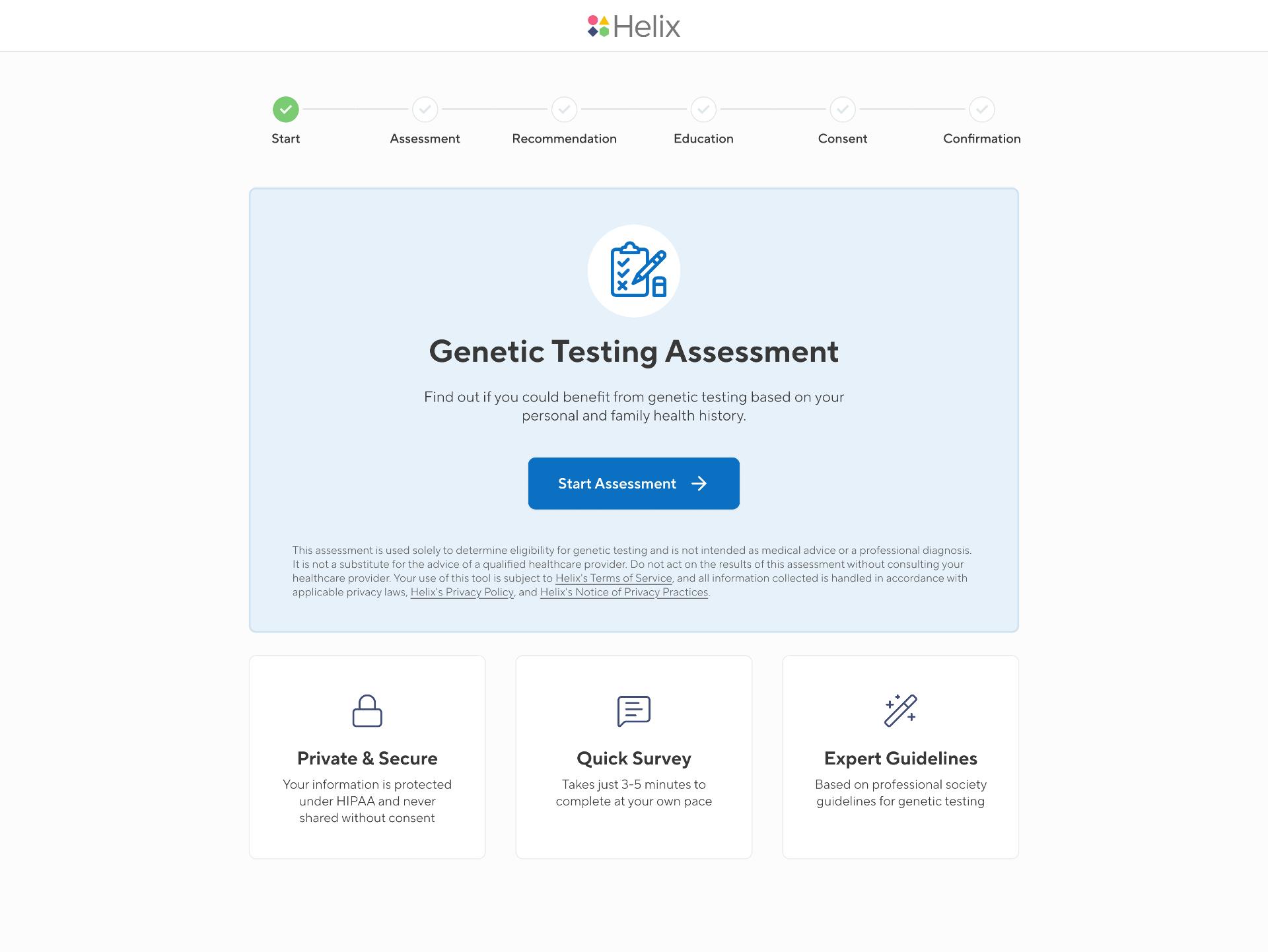
- Patients complete a guided assessment and educational consent at their own pace
- Potential eligibility is automatically flagged for provider review
- Prospective consent is documented and ordering simplified to a few clicks
- Designed to significantly reduce clinical time per patient assessed
Empowering your clinical team to lead
Evidence-based confidence
Provide specialists with the clear, guideline-backed justification they need to authorize testing at the point of care.
A seamless path to consent
Streamline administrative tasks by automating the delivery of education and obtaining digital informed consent, ensuring patients are prepared if their provider determines testing is appropriate.
Reclaiming professional expertise
Free your genetic counselors to focus on complex cases and high-value care coordination while the assessment handles routine intake and education.
Significantly reduce clinical time
Automate eligibility screening, patient education, and consent collection to dramatically cut the time clinicians spend per patient assessed.
Closing the gap between patient history and clinical action.
Relevant personal and family history can sometimes be difficult to surface within standard patient records, creating potential gaps in proactive care delivery. Our genetic risk assessment utilizes rules-based logic to systematically surface these individuals through digital patient intake, aligning patient data with national clinical guidelines, and ensuring that patients who meet the criteria are identified and their providers are equipped to initiate proactive, evidence-based care.
A more human experience through digital efficiency
We believe precision health should be accessible to everyone. By prioritizing a streamlined and intuitive design, we've created an assessment experience focused on ease of use — ensuring a simple and supportive workflow for both patients and providers.
Sign up for our portal, and try genetic risk assessment today.
A guideline-driven workflow that saves you time.
A streamlined genetic testing workflow designed to significantly reduce clinical time per patient while delivering guidelines-based, personalized care.
Patient Completes Assessment
Patient fills out a guided Genetic Risk Assessment — quick, simple, and done in minutes.
Potential Eligibility Flagged for Review
The system evaluates responses against clinical guidelines and identifies potential eligibility for genetic testing.
Patient Education & Informed Consent
Patient is educated and prospective informed consent is collected electronically — no paper, no delays, fully documented.
Test Order Flagged for Provider
A draft test order is automatically generated and flagged in the provider's queue for eligible patients, ready for review.
Provider Clicks "Order"
The provider reviews the guidelines-based order summary and finalizes with just a few clicks.
Start Saving Time Today
By streamlining eligibility, consent, and order preparation, providers can focus on what matters most — delivering guidelines-based, personalized care.
Ready to scale your precision health program?
Discover how streamlining identification of patients meeting clinical guidelines for genetic testing can help your team work at the top of their license and improve patient outcomes.
Provider FAQs
Common questions about the Genetic Risk Assessment tool for clinical teams.
This secure, digital, patient-facing tool collects family and personal history information related to hereditary cancer and inherited cardiovascular conditions. It applies published clinical guidelines (see question 2 below) to assess whether patients may meet criteria for genetic testing. The tool is intended to support, not replace, the provider's independent clinical judgment. All testing decisions require provider review and approval.
Because all inputs are patient self-reported, results depend on the completeness and accuracy of information provided; incomplete family history or unknown diagnoses may affect the determination. The underlying guidelines may not be equally representative across all ancestries or patient populations. The provider summary identifies which criteria were or were not met, the patient-reported data supporting each determination, and any flags requiring follow-up (e.g., known familial variants, prior genetic testing, incomplete responses).
The cardiovascular tool applies guidance from the following organizations:
- National Lipid Association
- American Heart Association
- American College of Cardiology
- American Medical Society for Sports Medicine
- Society for Cardiovascular Magnetic Resonance
- Pediatric and Congenital Electrophysiology Society
- European Society of Cardiology
- European Heart Rhythm Association
- Heart Rhythm Society
- Asia Pacific Heart Rhythm Society
- Latin American Heart Rhythm Society
- JACC Scientific Expert Panel
- Canadian Cardiovascular Society
The cancer tool applies guidance from the following organizations:
- American College of Medical Genetics and Genomics (ACMG)
- American Society of Breast Surgeons (ASBrS)
- American Society of Clinical Oncology (ASCO)
- Collaborative Group of the Americas on Inherited Gastrointestinal Cancer (CGA-IGC)
- National Comprehensive Cancer Network (NCCN)
- National Society of Genetic Counselors (NSGC)
- Philadelphia Prostate Cancer Consensus Conference
- Society of Gynecologic Oncology (SGO)
- Society of Surgical Oncology (SSO)
- US Preventive Services Task Force (USPSTF)
Criteria are algorithmically applied to standardize eligibility assessment.
The tool is appropriate for primary care, cardiology, oncology, women's health, genetics and preventive medicine clinics.
Patients enter structured information for themselves and their biological relatives, including:
- Cancer type or cardiac condition
- Age at diagnosis
- Ancestry/ethnicity
- Known genetic diagnoses in the family
Providers receive a structured clinical assessment summary that includes:
- Relevant personal and family history details
- Whether genetic testing criteria may be met based on patient-reported information
- Any follow-up flags (e.g., prior genetic testing, known familial variants, etc.)
The summary is designed for efficient review and documentation. The assessment summary is passed back to the health system as a PDF for ease of incorporation into the electronic health record. Providers also receive a PDF of the signed informed consent, when applicable.
Patients who meet criteria are provided with education about genetic testing, including its benefits, risks, and limitations, as well as an opportunity to provide prospective informed consent for testing. If the patient completes education and provides informed consent, a Helix test order will be drafted in the provider portal. A PDF of the consent form is then passed back to the health system for inclusion in the electronic health record. Provider review and approval is required before any order is finalized.
Patients who do not meet criteria for testing will be advised to follow up with their healthcare provider. The provider retains discretion to order testing based on their independent clinical judgment regardless of the tool's assessment.
The Helix Provider Portal™ includes a Risk Assessment Dashboard, which displays the status, outcome and order status for each patient who is sent a risk assessment link.
If a patient reports a known pathogenic or likely pathogenic variant in the family, the case is flagged as “follow-up required.” This alerts the provider that family variant testing and/or genetics referral may be appropriate.
If criteria are met and the patient provides prospective informed consent, a draft test order will be sent to the provider portal. The provider independently reviews the assessment and must approve the order before it is finalized. The specific test is pre-determined by collaboration with the provider and can be changed by the provider prior to test order approval.
Genetic counseling is not embedded. Patients who meet criteria are provided:
- A brief (6-minute) educational video about genetic testing
- Written information about benefits, risks, and limitations
- An opportunity to provide prospective electronic informed consent
Patients who do not meet criteria are informed that their responses have been shared with their provider for review. Referral to genetics professionals remains at the provider’s discretion.
No. The tool does not diagnose hereditary syndromes or cardiovascular disease. It assesses whether guideline-based criteria for genetic testing are met.
Cardiology
- Ahmad Z, Agarwala A, Cuchel M, et al. Update on familial hypercholesterolemia: An expert clinical consensus from the National Lipid Association. J Clin Lipidol. 2026 Jan 29:S1933-2874(26)00010-3. doi: 10.1016/j.jacl.2026.01.011. PMID: 41741298.
- Ommen SR, Ho CY, Asif IM, et al. 2024 AHA/ACC/AMSSM/HRS/PACES/SCMR Guideline for the Management of Hypertrophic Cardiomyopathy. Circulation. 2024;149(23):e1239–e1311.
- Arbelo E, Protonotarios A, Gimeno JR, et al. 2023 ESC Guidelines for the management of cardiomyopathies. Eur Heart J. 2023;44(37):3503–3626.
- Heidenreich PA, Bozkurt B, Aguilar D, et al. 2022 AHA/ACC/HFSA Guideline for the Management of Heart Failure. Circulation. 2022;145(18):e895–e1032.
- Wilde AAM, Semsarian C, Márquez MF, et al. EHRA/HRS/APHRS/LAHRS Expert Consensus Statement on the State of Genetic Testing for Cardiac Diseases. Heart Rhythm. 2022;19(7):e1–e60.
- Zeppenfeld K, Tfelt-Hansen J, de Riva M, et al. 2022 ESC Guidelines for the management of patients with ventricular arrhythmias and the prevention of sudden cardiac death. Eur Heart J. 2022;43(40):3997–4126.
- Isselbacher EM. 2022 ACC/AHA Guideline for the Diagnosis and Management of Aortic Disease. Circulation. 2022;146(24):e334–e482.
- Stiles MK, Wilde AAM, Abrams DJ, et al. 2020 APHRS/HRS expert consensus statement on the investigation of decedents with sudden unexplained death. Heart Rhythm. 2021;18(1):e1–e50.
- Brown EE, Sturm AC, Cuchel M, et al. Genetic testing in dyslipidemia: A scientific statement from the National Lipid Association. J Clin Lipidol. 2020;14(4):398–413.
- Musunuru K, Hershberger RE, Day SM, et al. Genetic Testing for Inherited Cardiovascular Diseases: A Scientific Statement From the American Heart Association. Circ Genom Precis Med. 2020;13(4):e000067.
- Towbin JA, McKenna WJ, Abrams DJ, et al. 2019 HRS expert consensus statement on evaluation, risk stratification, and management of arrhythmogenic cardiomyopathy. Heart Rhythm. 2019;16(11):e301–e372.
- Brunham LR, Ruel I, Aljenedil S, et al. Canadian Cardiovascular Society Position Statement on Familial Hypercholesterolemia: Update 2018. Can J Cardiol. 2018;34(12):1553–1563.
- Hershberger RE, Givertz MM, Ho CY, et al. Genetic Evaluation of Cardiomyopathy—A Heart Failure Society of America Practice Guideline. J Card Fail. 2018;24(5):281–302.
- Sturm AC, Knowles JW, Gidding SS, et al. Clinical Genetic Testing for Familial Hypercholesterolemia: JACC Scientific Expert Panel. J Am Coll Cardiol. 2018;72(6):662–680.
- Al-Khatib SM, Stevenson WG, Ackerman MJ, et al. 2017 AHA/ACC/HRS Guideline for Management of Patients With Ventricular Arrhythmias and the Prevention of Sudden Cardiac Death. Circulation. 2018;138(13):e272–e391.
- Eichstaedt CA, Belge C, Chung WK, et al. Genetic counselling and testing in pulmonary arterial hypertension: a consensus statement. Eur Respir J. 2023;61(2):2201471.
- Elliott CG. Genetic Counseling and Testing in Pulmonary Arterial Hypertension. Methodist Debakey Cardiovasc J. 2021;17(2):101–105.
- Shen WK, Sheldon RS, Benditt DG, et al. 2017 ACC/AHA/HRS Guideline for the Evaluation and Management of Patients With Syncope. Circulation. 2017;136(5):e60–e122.
Oncology
- Bedrosian I, Somerfield MR, Achatz MI, et al. Germline Testing in Patients With Breast Cancer: ASCO-Society of Surgical Oncology Guideline. J Clin Oncol. 2024;42(5):584–604.
- Giri VN, Knudsen KE, Kelly WK, et al. Implementation of Germline Testing for Prostate Cancer: Philadelphia Prostate Cancer Consensus Conference 2019. J Clin Oncol. 2020;38(24):2798–2811.
- Gressel GM, Frey MK, Norquist B, et al. Germline and somatic testing for ovarian Cancer: An SGO clinical practice statement. Gynecol Oncol. 2024;181:170–178.
- Heald B, Hampel H, Church J, et al. Collaborative Group of the Americas on Inherited Gastrointestinal Cancer Position statement on multigene panel testing for patients with colorectal cancer and/or polyposis. Familial Cancer. 2020;19(3):223–239.
- Konstantinopoulos PA, Norquist B, Lacchetti C, et al. Germline and Somatic Tumor Testing in Epithelial Ovarian Cancer: ASCO Guideline. J Clin Oncol. 2020;38(11):1222–1245.
- Manahan ER, Kuerer HM, Sebastian M, et al. Consensus Guidelines on Genetic Testing for Hereditary Breast Cancer from the American Society of Breast Surgeons. Ann Surg Oncol. 2019;26(10):3025–3031.
- Mao R, Krautscheid P, Graham RP, et al. Genetic testing for inherited colorectal cancer and polyposis, 2021 revision: A technical standard of the ACMG. Genet Med. 2021;23(10):1807–1817.
- National Comprehensive Cancer Network. NCCN Clinical Practice Guidelines in Oncology: Genetic/Familial High-Risk Assessment: Colorectal, Endometrial, and Gastric (Version 1.2025).
- National Comprehensive Cancer Network. NCCN Clinical Practice Guidelines in Oncology: Neuroendocrine and Adrenal Tumors (Version 3.2025).
- National Comprehensive Cancer Network. NCCN Clinical Practice Guidelines in Oncology: Acute Myeloid Leukemia (Version 3.2026).
- National Comprehensive Cancer Network. NCCN Clinical Practice Guidelines in Oncology: Genetic/Familial High-Risk Assessment: Breast, Ovarian, Pancreatic and Prostate (Version 3.2026).
- National Comprehensive Cancer Network. NCCN Clinical Practice Guidelines in Oncology: Hereditary Renal Cell Carcinoma (Version 1.2026).
- National Comprehensive Cancer Network. NCCN Clinical Practice Guidelines in Oncology: Melanoma: Cutaneous (Version 1.2026).
- National Comprehensive Cancer Network. NCCN Clinical Practice Guidelines in Oncology: Myelodysplastic Syndromes (Version 3.2026).
- Pathak S & Puckett Y. Cutaneous Malignant Melanoma: Guideline-Based Management and Interprofessional Collaboration. StatPearls [Internet]. 2025.
- Randall LM, Pothuri B, Swisher EM, et al. Multi-disciplinary summit on genetics services for women with gynecologic cancers: A Society of Gynecologic Oncology White Paper. Gynecol Oncol. 2017;146(2):217–224.
- Stewart BL, Helber H, Bannon SA, et al. Risk assessment and genetic counseling for hematologic malignancies—Practice resource of the National Society of Genetic Counselors. J Genet Couns. 2025;34:e1959.
- Stoffel EM, McKernin SE, Brand R, et al. Evaluating Susceptibility to Pancreatic Cancer: ASCO Provisional Clinical Opinion. J Clin Oncol. 2019;37(2):153–164.
- US Preventive Services Task Force. Risk Assessment, Genetic Counseling, and Genetic Testing for BRCA-Related Cancer: US Preventive Services Task Force Recommendation Statement. JAMA. 2019;322(7):652–665.
Patient FAQs
Common questions about the Family Health History Tool and genetic testing process.
This tool is a secure, online tool that helps you record your family’s medical history, especially for cancer and heart conditions. It reviews your information to see if you meet guidelines for genetic testing. By sharing the health history of your blood relatives, you and your healthcare provider can better understand your personal risk for cancer and heart disease.
Your family’s health history can affect your risk for certain diseases. Sometimes diseases “run in the family” due to shared genes, environment, and lifestyle. Finding these patterns early helps your healthcare provider:
- Recommend earlier or more frequent screenings (such as mammograms or colonoscopies).
- Decide if genetic testing may be helpful.
- Talk with you about lifestyle changes that may lower your risk.
The process is simple and usually takes 15–20 minutes:
- Gather Information: Talk to your parents, siblings, and extended family (grandparents, aunts, uncles) about their health history.
- Enter Data: Type in the medical conditions they have had, including age of diagnosis, if you know it. You will not be including names, birth dates or other identifying information.
- Review & Share: When you’re done, the tool will create a summary that you can print or electronically share with your healthcare provider.
It is most helpful to gather health information from your first and second-degree relatives. First-degree relatives include your children, siblings and parents. Second-degree relatives include your grandparents, grandchildren, aunts, uncles, nieces, nephews and half-siblings. Try to collect the following information:
- Their current age (or age at death).
- Any history of cancer or heart disease, including heart attack, high cholesterol or other heart conditions and type of cancer.
- The age they were when they were first diagnosed.
- Their ancestry or ethnic background, since some conditions are more common in certain groups.
Yes. Even some family history is helpful. If you only know about your parents and siblings, that is a great place to start. You can save your progress and come back later if you learn more from other relatives. If you were adopted, choose “unknown” for any questions you cannot answer.
No. This tool looks only at cancer or heart disease to see if you may meet guidelines for genetic testing. Other medical conditions are not included because they are not needed for this review. The cancer and heart disease sections are checked separately.
If you do not see your condition listed, it is not likely used in the assessment of meeting guidelines for genetic testing. You should always discuss your personal and family history with your provider.
This tool uses your family and personal history to see if you meet criteria for genetic testing. It collects information and checks criteria, but does not create a family tree or pedigree. The result is a medical summary that your healthcare provider can review easily.
Your personal and family health information is protected under the Health Insurance Portability and Accountability Act (HIPAA). The information you provide through this tool is used to assess whether you meet clinical guidelines for genetic testing and to support your care team in managing your health. Your information is shared with your healthcare provider and is used and disclosed only as permitted by law.
Helix’s Notice of Privacy Practices describes how your health information may be used, shared, and protected. You can review it at https://www.helix.com/notice-of-privacy-practices.
No. This tool only checks whether you meet guidelines for genetic testing, it does not provide a medical diagnosis. You should review your results and any other personal and family history with a qualified healthcare provider to decide next steps in your care.
If you meet criteria for genetic testing, the tool will offer more information through a short video and written materials. You will also have the option to review and sign a consent form for testing. Your healthcare provider will receive your risk results and may decide to order genetic testing for you.
If you do not meet criteria for genetic testing, or if follow up is required, your healthcare provider will talk with you about next steps. If you have an appointment with your provider, it is important that you keep it. Regardless of whether you meet guidelines, you and your provider should review your personal and family history to decide on next steps and whether genetic testing may be beneficial.
The genetic testing assessment is sent to select patients within a health system who have a defined health care team to manage the results of their assessment. Do not forward your link to other family members. If other family members are interested in the genetic testing assessment, they should speak with their provider. Providers can reach out to Helix at (844) 211-2070 to enable the ability to send genetic testing assessment to patients. Once a link is sent to individual patients, each adult will have their own assessment to ensure their personal health data and risk assessments are managed correctly. However, you are encouraged to share the information you’ve gathered with your siblings, children and other family members so they can use it for their own health records.
Need help? If you have technical issues while using the tool please contact our support team at support@helix.com or (844) 211-2070.